
5 multiple-choice questions
1A sales forecast is best described as:
2For one month at a bottling plant, which of these is a fixed cost?
3A plant gives 30 days' credit. Month 1's receipts on its cash-flow forecast are:
4Which of these is a purpose of a budget?
5A plant sells 18,000 cases at $6.50 each. Its sales revenue is:
The definition examiners want
Define the term 'margin of safety'.
Say it out loud or jot it down first. Then check it against the mark scheme.
Two marks means two separate things to say and the second is not a rewording of the first. Before you write, settle what KIND of quantity this is — the commonest loss of a mark here is answering in money when the term is measured in something else.
The margin of safety is the difference between a firm's current or forecast output and its break-even point (1 mark), measured in units of output, and it shows how far sales could fall before the firm stopped covering its costs (1 mark). For the plant, 20,000 − 15,000 = 5,000 cases. An answer giving a money figure has described the profit at that output instead, which is a different quantity.
The diagrams to know
Step through each one, then try drawing it yourself.
Melaka Bottling: the break-even chart
Melaka Bottling: cash-flow forecast, three months
Melaka Bottling: Month 2 budget against actual
Financial Planning diagrams to save
Open one full size, or save it to revise from.
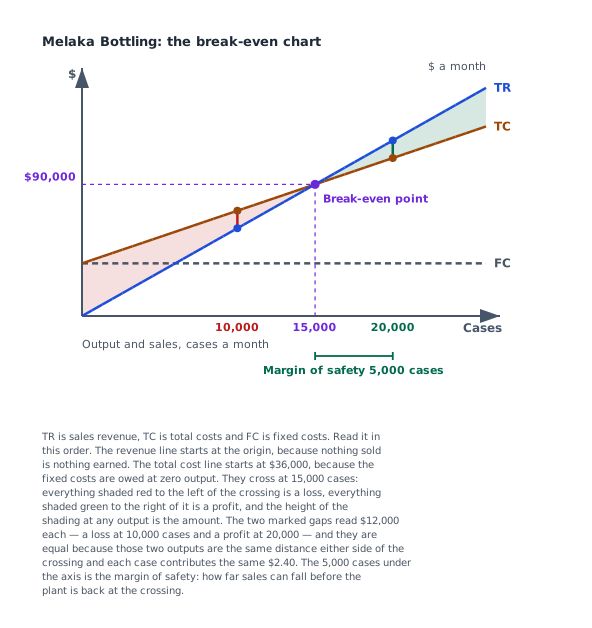
Melaka Bottling: the break-even chart
Worked calculations
Try it on paper first, then open the working.
A bottling plant has fixed costs of $36,000 a month and a variable cost of $3.60 a case. Calculate its total cost and its average cost at an output of 25,000 cases.
Two figures are wanted and the second is built out of the first, so do them in order and label both. Appendix 6 says a Calculate requires workings to be shown, and here the workings are where the marks are — decide which total you need before you divide anything.
Total variable cost is $3.60 × 25,000 = $90,000 (1 mark). Total cost is $36,000 + $90,000 = $126,000 (1 mark). Average cost is total cost divided by output: $126,000 ÷ 25,000 (1 mark) = $5.04 a case (1 mark). Dividing only the fixed costs gives $1.44 and dividing only the variable costs gives $3.60; both leave half the total out.
A bottling plant sells at $6 a case with a variable cost of $3.60 a case and fixed costs of $36,000 a month. Calculate its break-even point, and calculate the new break-even point if the variable cost rises to $4.
Two break-even points, and the second is the first done again with one figure changed. Appendix 6 requires workings, and on this question the working that matters is the line before the division — get that wrong and both answers are wrong together. Note which of the three given figures actually moves.
Contribution is $6 − $3.60 = $2.40 (1 mark), so the break-even point is $36,000 ÷ $2.40 = 15,000 cases (1 mark). With variable cost at $4, contribution falls to $2 (1 mark) and the break-even point becomes $36,000 ÷ $2 = 18,000 cases (1 mark). The fixed costs never changed, so an answer that adjusts them has moved the wrong figure; dividing by the price rather than the contribution gives 6,000 and misses what contribution is for.
A 10-mark Assess question
A bottling plant budgets historically: each line is last year's actual figure adjusted for expected changes. Its finance manager has found a service contract for equipment sold two years ago, and proposes moving the whole firm to zero-based budgeting from next year. Assess whether the plant should do so.
0 words
Questions students ask
How do you calculate the margin of safety?
Margin of safety = actual (or planned) output − break-even output. For example, if a business sells 20,000 units and its break-even point is 12,000 units, its margin of safety is 8,000 units. This means sales could fall by 8,000 units before the business starts to make a loss. A bigger margin of safety means less risk.
What are the limitations of break-even analysis?
Break-even analysis assumes that the selling price and the variable cost per unit stay the same at every level of output, and that every unit made is sold. In real life, firms give discounts for large orders, costs change, and some output is not sold. Fixed costs can also rise when output grows. So the break-even point is only an estimate.
What is variance analysis in a budget?
A variance is the difference between the budgeted figure and the actual figure. A favourable variance is better for profit than planned: revenue is higher, or costs are lower, than the budget. An adverse variance is worse for profit: revenue is lower, or costs are higher. Managers look at large variances to find out what went wrong, or right, and why.
Test me on all of Financial Planning
Every quiz question on the topic, not just the five above.
When you’re done
Edexcel IAL WBS12 · Spec 2.3.2 · A-Level Business