
5 multiple-choice questions
1Unlimited liability means that the owner of a business:
2Which statement about the cost of retained profit is correct?
3The main difference between a bank loan and share capital is that share capital:
4Which circumstance most strongly favours equity finance over a bank loan?
5A sole trader cannot raise finance by issuing shares because:
The definition examiners want
Define the term 'retained profit'.
Say it out loud or jot it down first. Then check it against the mark scheme.
Retained profit is the profit that remains after tax has been paid and any dividends have been distributed to shareholders.
The business keeps this amount rather than paying it out to its owners, so it can be reinvested, for example in new equipment. It is an internal source of finance because it comes from the business’s own trading, not from anyone outside it.
Where the marks come from
- 1 The profit that remains after tax has been paid and dividends have been distributed to shareholders
- 1 Kept in the business, where it can be reinvested, rather than paid out to the owners
The diagrams to know
Step through each one, then try drawing it yourself.
The Funding Package, Debt against Equity, and What Each Method Costs
How Yusra Foods funded $240,000 from four sources, the single distinction underneath every method of external finance, and the total cost of a loan, a lease, trade credit, an overdraft and a grant.
Retained Profit and What It Costs
How $48,000 of profit after tax becomes $36,000 of retained profit once $12,000 of dividends are paid, and the opportunity cost of keeping it in the business rather than using it elsewhere.
Finance Appropriate to Limited and Unlimited Liability Businesses
Which sources and methods of finance are open to an unlimited liability business and which require a company, with the single cause behind every difference: only a company has shares to sell.
Raising Finance diagrams to save
Open one full size, or save it to revise from.
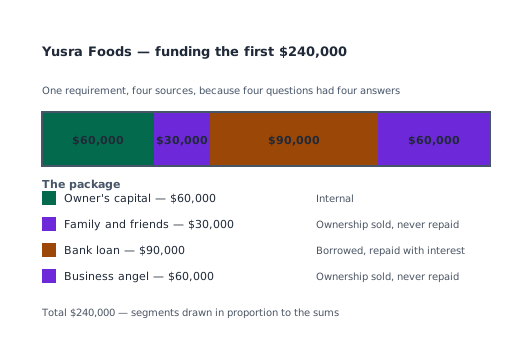
The Funding Package, Debt against Equity, and What Each Method Costs: Funding the first $240,000 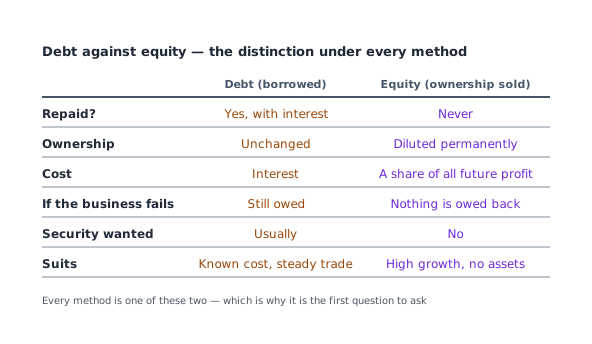
The Funding Package, Debt against Equity, and What Each Method Costs: Debt against equity 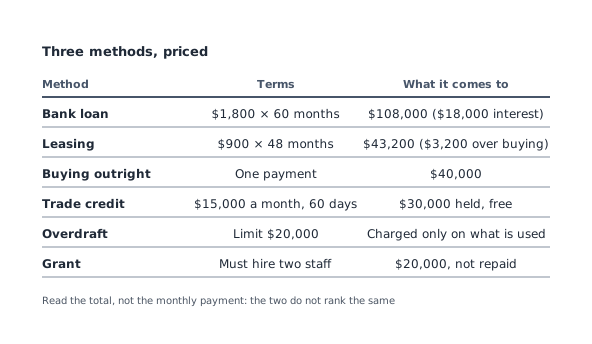
The Funding Package, Debt against Equity, and What Each Method Costs: Three methods, priced 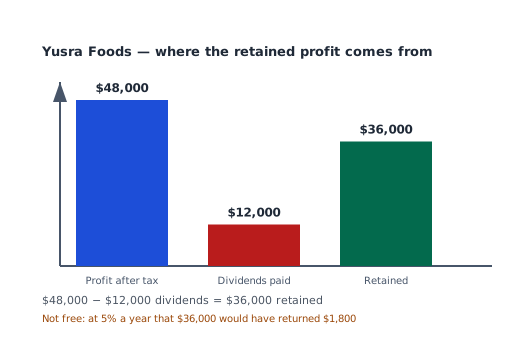
Retained Profit and What It Costs 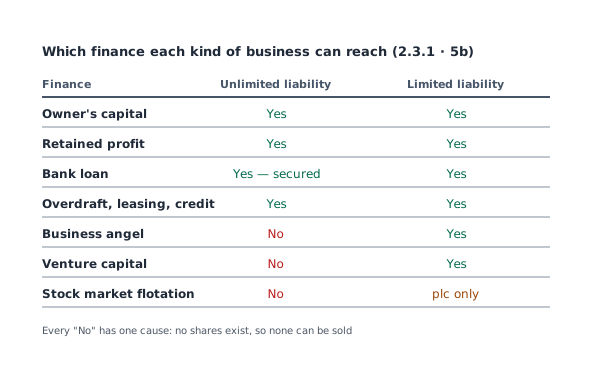
Finance Appropriate to Limited and Unlimited Liability Businesses
Worked calculations
Try it on paper first, then open the working.
A business can buy a machine for $40,000 or lease it for $900 a month over 48 months. Calculate the additional cost of leasing rather than buying.
To compare the two options, I need the total cost of leasing over the whole agreement, which is the monthly payment multiplied by the number of months. The additional cost is that total minus the purchase price.
Total cost of leasing = $900 × 48 months = $43,200.
Additional cost of leasing = $43,200 − $40,000 = $3,200. So leasing the machine costs the business $3,200 more than buying it outright. In exchange, the business avoids paying $40,000 in one go.
| Marking point | Marks |
|---|---|
| Method set out: the total cost of leasing is the monthly payment multiplied by the number of months, and the extra cost is that total minus the purchase price | 1 mark |
| Total cost of leasing: $900 × 48 = $43,200 | 1 mark |
| The comparison set up: $43,200 − $40,000 | 1 mark |
| Additional cost of leasing = $3,200, stated as how much more leasing costs than buying over the 48 months | 1 mark |
| Total | 4 |
A 10-mark Assess question
A profitable partnership running three restaurants plans to open ten more and needs finance it cannot generate itself. Assess whether it should incorporate as a private limited company.
How to approach it: Set out what becoming a private limited company would change for these partners, in finance and in risk, then weigh that against what it would cost them. Your judgement should say which of their circumstances decides it.
0 words
Questions students ask
What does a business plan include?
A business plan usually describes the business idea and its aims, the market and the competition, the marketing plan, how the business will run, and the people who will run it. It also has financial forecasts: expected sales, costs, cash flow and profit, and how much finance is needed. Banks and investors read it before they lend or invest.
What is the difference between a bank loan and an overdraft?
A loan is a fixed amount borrowed for a set time, often several years, and repaid in regular instalments with interest. It suits long-term needs such as buying equipment. An overdraft lets a business take more money out of its bank account than it has, up to an agreed limit. It is flexible and suits short-term cash-flow gaps, but the interest rate is usually higher.
What are crowd funding and peer-to-peer funding?
In crowd funding, a business raises money from a large number of people, usually through a website. Each person gives a small amount, sometimes in return for a reward or a share in the business. In peer-to-peer funding, people lend money to a business through an online platform, without a bank in the middle, and the business repays the loan with interest.
Test me on all of Raising Finance
Every quiz question on the topic, not just the five above.
When you’re done
Edexcel IAL WBS12 · Spec 2.3.1 · A-Level Business