
5 multiple-choice questions
1Lantana Tiles has a gross profit of $700,000 on revenue of $2,000,000. Its gross profit margin is:
2Which figure does the specification also call net profit?
3A statement of comprehensive income differs from a statement of financial position because it:
4Lantana Tiles earned $160,000 of profit for the year and its bank balance fell by $100,000. The most likely explanation is that it:
5Overtrading means that a business:
The definition examiners want
Define the term 'profit for the year'.
Say it out loud or jot it down first. Then check it against the mark scheme.
Two marks means two separate things to say, and the second is not a rewording of the first. Settle first which figure it is measured from, and then what has been taken off to reach it. An answer that says "the profit a business makes" has said neither.
Profit for the year is the profit remaining after interest has been deducted from operating profit (1 mark), and it is the figure available to the owners of the business (1 mark). The specification also calls it net profit, and either name is acceptable. An answer that describes it as the profit after all costs, without naming interest or the line it is measured from, has given one general statement rather than two specific ones.
The diagrams to know
Step through each one, then try drawing it yourself.
Measuring Profitability
IAL 2.3.3 · 1c: the three margins with the gap each one measures, and what a five per cent price cut does to the operating line.
Profit Against Cash
IAL 2.3.3 · 2a: the six things that stand between a year's profit and the movement in the bank balance.
How Businesses Fail
IAL 2.3.3 · 3a and 3b: each cause of failure priced on the line of the statement it lands on, and the chain that turns an external shock into a closure.
Managing Finance diagrams to save
Open one full size, or save it to revise from.
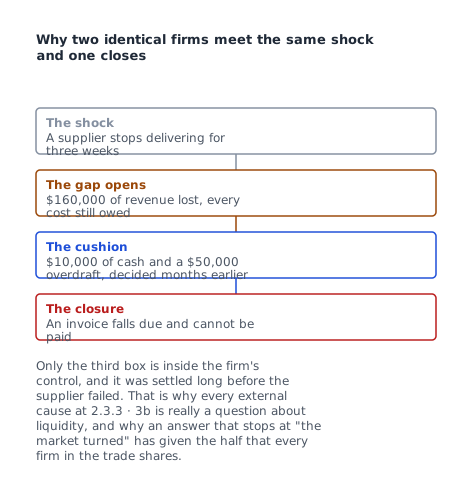
How Businesses Fail
Worked calculations
Try it on paper first, then open the working.
A tile wholesaler reports, for the year: revenue $2,000,000, cost of sales $1,300,000, other operating expenses $500,000, interest $40,000. Calculate the wholesaler's gross profit, operating profit and profit for the year.
Work down the ladder in the specification's own order rather than reaching for the figure the question names last. Each line you produce is the starting point for the next, so setting them out in sequence is both the method and the workings. Label each figure: three unlabelled numbers cannot be told apart.
Gross profit = revenue − cost of sales = $700,000 (1 mark). Operating profit = gross profit − other operating expenses = $200,000 (1 mark). Profit for the year = operating profit − interest = $160,000 (1 mark). A further mark is available for correctly labelled workings that show the three subtractions in order. An answer that reaches $160,000 with no intermediate lines has produced the right figure and shown none of the method the question asked for.
A tile wholesaler's statement of financial position shows: inventory $240,000, trade receivables $150,000, cash $10,000, trade payables $180,000, bank overdraft $50,000, other payables $20,000, non-current assets $900,000, bank loan repayable in five years $500,000. Calculate the wholesaler's current ratio and its acid test ratio.
Before any arithmetic, sort the figures you have been given: some of them belong in this calculation and some are there to see whether you know they do not. The test in both cases is the same word, and it appears on both sides of each ratio. Then remember what the second measure removes and why.
Current assets = $240,000 + $150,000 + $10,000 = $400,000; current liabilities = $180,000 + $50,000 + $20,000 = $250,000 (1 mark for each total). Current ratio = $400,000 ÷ $250,000 = 1.60:1 (1 mark). Acid test = ($400,000 − $240,000) ÷ $250,000 = 0.64:1 (1 mark). The non-current assets and the five-year loan belong in neither calculation; including them gives 1.73:1 and answers a question nobody asked.
A 10-mark Assess question
Assess the importance of managing liquidity for a small wholesaler whose sales are growing rapidly.
0 words
Questions students ask
What is a good current ratio and acid test ratio?
There is no single right answer, but a current ratio of about 1.5 to 2 and an acid test ratio of about 1 are often seen as healthy. Below these figures, the business may struggle to pay its short-term debts. A very high ratio can mean too much money is tied up in inventory or cash that is not being used. Always compare with past years and similar businesses.
How can a business improve its liquidity?
It can sell assets it no longer needs, or sell and lease them back. It can ask suppliers for longer credit terms, so it pays later. It can use factoring: selling what customers owe to a factoring company for cash now. It can hold less inventory, for example by using just-in-time (JIT). Each method brings cash in sooner or sends it out later.
How can a business increase its profit?
A business can raise revenue, for example by raising prices or selling more through better marketing. It can also cut costs: find cheaper suppliers, cut waste, or make workers more productive. Each method has a risk. A price rise may cut sales if demand is price elastic, and cheaper materials may lower quality.
Test me on all of Managing Finance
Every quiz question on the topic, not just the five above.
When you’re done
Edexcel IAL WBS12 · Spec 2.3.3 · A-Level Business