
5 multiple-choice questions
1Aggregate demand is best described as:
2In the identity AD = C + I + G + (X − M), imports are subtracted because:
3An economy has consumption of $500bn, investment of $120bn, government expenditure of $160bn, exports of $90bn and imports of $140bn. Its aggregate demand is:
4Which change causes a movement ALONG the aggregate demand curve rather than a shift?
5Which of these is part of government expenditure (G) in the AD identity?
The definition examiners want
Define the term ‘aggregate demand’.
Say it out loud or jot it down first. Then check it against the mark scheme.
Two marks means two separate things to say, and the second must not be a rewording of the first. Settle first what KIND of quantity this is, because everything else follows from that choice.
Aggregate demand is the total planned spending on a country’s own output (1 mark), measured at each price level over a period of time (1 mark). An answer that says "the total demand in an economy" has restated the words of the term without giving either of them, and one that says "everything that is bought" describes an outcome rather than a plan.
The diagrams to know
Step through each one, then try drawing it yourself.
The AD Curve, and What Moves It
The AD curve, and the difference between a movement along it and a shift of it. Every view starts from Norla's AD of $1,000bn at a price level of 100.
The price level changes and nothing else does, so the economy moves along its own curve. One curve, three points. At a price level of 94, real output demanded is $1,036bn; at 106, it is $964bn.
Consumption, Saving and the Savings Ratio
Norla's disposable income of $800bn split into consumption and saving at savings ratios of 15%, 20% and 25%, and the AD each gives.
Gross and Net Investment
Norla's gross investment, depreciation and net investment in a normal year and a weak year.
Aggregate Demand diagrams to save
Open one full size, or save it to revise from.
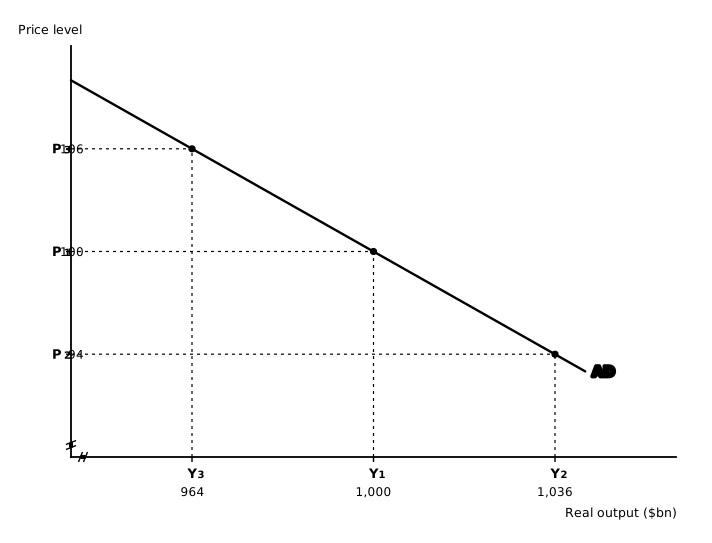
The AD Curve, and What Moves It: Movement along AD 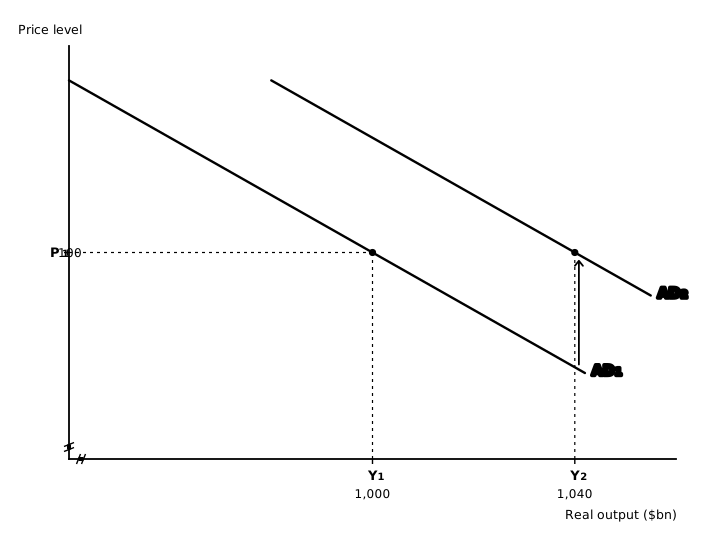
The AD Curve, and What Moves It: Shift of AD to the right 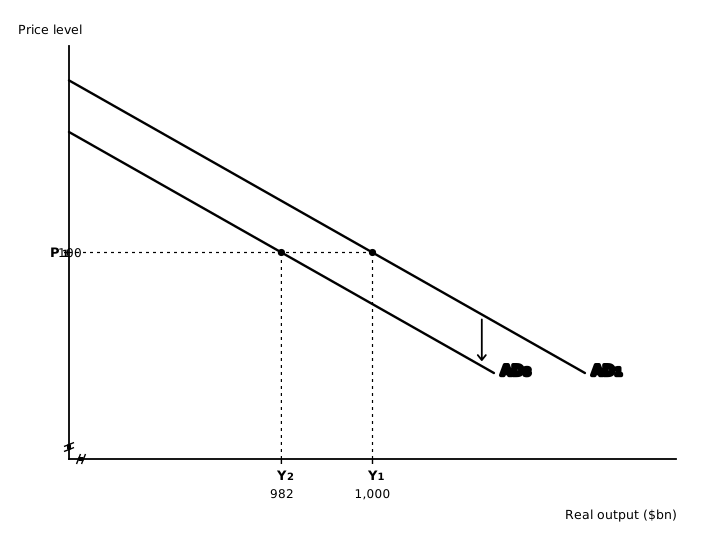
The AD Curve, and What Moves It: Shift of AD to the left
Worked calculations
Try it on paper first, then open the working.
An economy has disposable income of $900bn and a savings ratio of 18%. Investment is $200bn, government expenditure is $250bn, exports are $300bn and imports are $360bn. Calculate aggregate demand.
This is three short steps rather than one long one, and each of them can be written on its own line. Work out what is saved, then what is left to be consumed, then put the identity together.
Saving is 18% of $900bn = $162bn (1 mark). Consumption is $900bn − $162bn = $738bn (1 mark). The net trade balance is $300bn − $360bn = −$60bn (1 mark). Aggregate demand is $738bn + $200bn + $250bn − $60bn = $1,128bn (1 mark). Adding the trade figures rather than subtracting them is the error that costs the last two steps.
A 6-mark Analyse question
Analyse two factors that might cause a fall in investment in an economy.
0 words
Questions students ask
How is aggregate demand calculated?
Add the four components: AD = C + I + G + (X − M). For example, if consumption is $300bn, investment $80bn, government spending $100bn, exports $60bn and imports $90bn, then AD = 300 + 80 + 100 + (60 − 90) = $450bn. Imports are taken away because that spending buys goods made in other countries.
Why does the aggregate demand curve slope downwards?
Three reasons. At a higher price level, money buys less, so people demand less real output (the real balance effect). The country’s goods become less competitive, so exports fall and imports rise. And interest rates are likely to be higher, so investment falls.
What shifts the aggregate demand curve?
A change in any component of AD that does not come from the price level. For example, lower interest rates raise consumption and investment, more government spending raises G, and a fall in the exchange rate raises exports. All of these shift AD to the right. A change in the price level moves along the curve instead.
Test me on all of Aggregate Demand
Every quiz question on the topic, not just the five above.
When you’re done
Edexcel IAL WEC12 · Spec 2.3.2 · A-Level Economics