
5 multiple-choice questions
1Which of the following is a normative statement?
2Which of the following is most likely to be a free good?
3Along its frontier, Belvan moves from 20 thousand televisions and 60 thousand tonnes of maize to 40 thousand televisions and 55 thousand tonnes of maize. What is the opportunity cost of one extra television?
4The ceteris paribus assumption is used in economics to:
5Economics is described as a social science mainly because:
The definition examiners want
Define the term 'opportunity cost'.
Say it out loud or jot it down first. Then check it against the mark scheme.
Opportunity cost is the value of the next best alternative forgone when a choice is made.
Only the best option given up counts, not every option, and the cost is what that option was worth, which need not be money. A student who revises for an evening instead of working a paid shift bears the lost wages as the opportunity cost of revising.
Where the marks come from
- 1 The next best alternative: one alternative, not every option given up
- 1 Forgone when a choice is made
The diagrams to know
Step through each one, then try drawing it yourself.
Scarcity, Choice and Opportunity Cost
Wants have no limit, but the resources to meet them do, and that gap is scarcity. Scarcity forces a choice about what to produce, how to produce it and for whom. Every choice gives something up, and the next best alternative forgone is its opportunity cost.
Reading Opportunity Cost off the Frontier
Moving along Maraya’s frontier from C (20, 33) to D (30, 25) gains 10 thousand consumer goods and gives up 8 thousand capital goods, so each extra consumer good costs 8 ÷ 10 = 0.8 capital goods. Step by step the cost rises: 0.2, 0.5, 0.8, then more.
Gained: 30 − 20 = 10 thousand consumer goods. Given up: 33 − 25 = 8 thousand capital goods. 8 ÷ 10 = 0.8 capital goods per consumer good. Each step of 10 costs more: 0.2, 0.5, 0.8, then more.
Introductory Concepts diagrams to save
Open one full size, or save it to revise from.
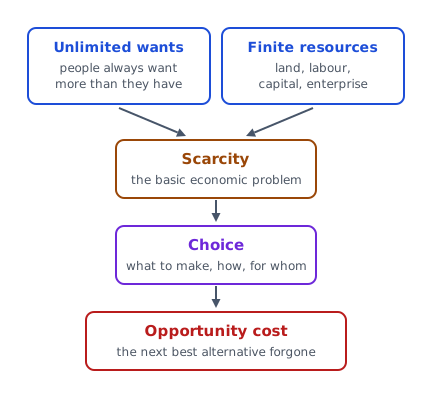
Scarcity, Choice and Opportunity Cost 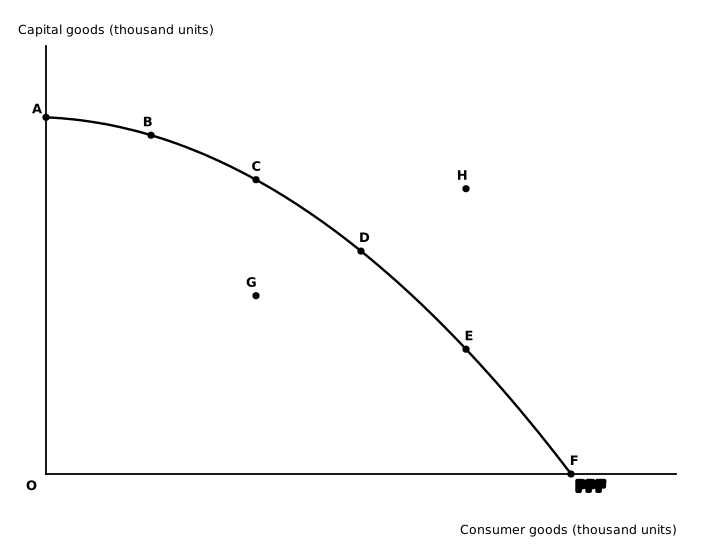
Maraya’s Production Possibility Frontier 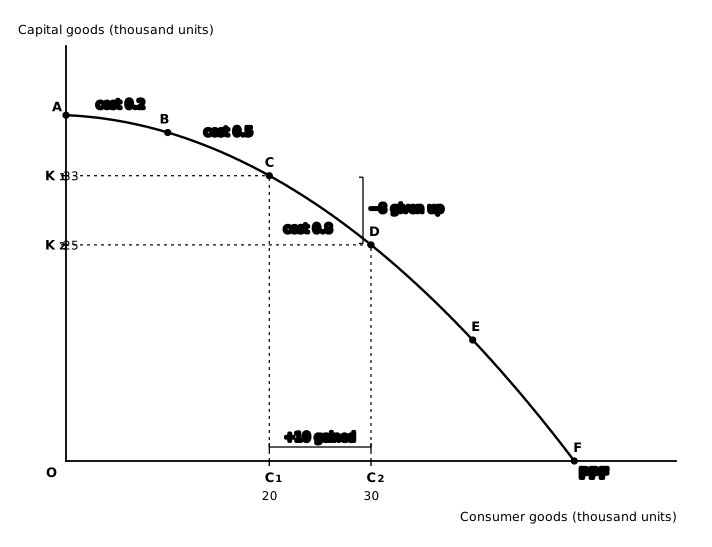
Reading Opportunity Cost off the Frontier
Worked calculations
Try it on paper first, then open the working.
Maraya’s Production Possibility Frontier
Maraya’s frontier, with capital goods on the vertical axis and consumer goods on the horizontal, both in thousands of units. Every point from A to F uses all of Maraya’s resources, and uses them well. G inside the frontier means some resources are unemployed or misallocated; H beyond it cannot be made with today’s resources.
On the frontier, A to F: productively efficient. Inside, G: resources unemployed or misallocated. Beyond, H: unattainable with today’s resources. A (0, 40), B (10, 38), C (20, 33), D (30, 25), E (40, 14), F (50, 0); G (20, 20); H (40, 32).
Maraya can produce 30 thousand consumer goods and 25 thousand capital goods (point D), or 40 thousand consumer goods and 14 thousand capital goods (point E). Calculate the opportunity cost of one extra consumer good in moving from D to E.
Moving from D to E, consumer goods rise from 30 thousand to 40 thousand, a gain of 10 thousand. Capital goods fall from 25 thousand to 14 thousand, so 11 thousand are given up.
The opportunity cost of one extra consumer good is what is given up divided by what is gained: 11 thousand ÷ 10 thousand = 1.1. So each extra consumer good costs 1.1 capital goods.
| Marking point | Marks |
|---|---|
| Consumer goods gained: 40 − 30 = 10 thousand | 1 mark |
| Capital goods given up: 25 − 14 = 11 thousand | 1 mark |
| Opportunity cost of one consumer good: 11 ÷ 10 = 1.1 | 1 mark |
| Unit stated: 1.1 capital goods per consumer good | 1 mark |
| Total | 4 |
A 6-mark Analyse question
Analyse two ways in which the state allocates resources in a mixed economy.
How to approach it: Choose two roles of the state and follow each one through to where resources end up, rather than listing several. For each, ask what the market would have done on its own and what the state changes.
0 words
Questions students ask
What is the basic economic problem? Give an example.
Wants are unlimited, but the resources to meet them are limited, so every choice means giving something up. For example, a government with a fixed budget must choose between building a new hospital and building a new school. It cannot have both, so it must decide what to produce.
What does “next best alternative” mean in economics?
When you make a choice, you give up the other options. The next best alternative is the option you would have chosen if your first choice was not possible. Its value is the opportunity cost of your choice. Only the next best option counts, not every option you gave up.
What does a production possibility frontier (PPF) show?
A PPF shows the most an economy can produce of two goods when it uses all its resources. A point on the curve is productively efficient. A point inside it means some resources are unemployed. A point outside it cannot be reached with today’s resources and technology. Moving along the curve shows the opportunity cost of producing more of one good.
Why is the PPF curve bowed outwards (concave)?
Resources are not equally good at making everything. As an economy makes more of one good, it has to move resources that are less suited to making it. So each extra unit costs more and more of the other good: the opportunity cost rises. A straight-line PPF would mean the opportunity cost stays the same.
What makes a PPF shift outwards?
An increase in the quantity or quality of the factors of production: for example better-educated workers, new technology or machines, or a new oil field. This is economic growth, because the economy can now produce more of both goods. A natural disaster that destroys resources can shift the PPF inwards.
Test me on all of Introductory Concepts
Every quiz question on the topic, not just the five above.
When you’re done
Edexcel IAL WEC11 · Spec 1.3.1 · A-Level Economics