
5 multiple-choice questions
1Supply-side policies differ from demand-side policies because they:
2Central bank independence normally means the bank is independent in:
3An economy's nominal GDP rises by 4% while its price level rises by 4%. Real GDP has:
4A government collects $150bn in tax revenue and spends $180bn in a year. Its budget position is a:
5Which of these is NOT a monetary policy instrument?
The definition examiners want
Define the term 'inflation'.
Say it out loud or jot it down first. Then check it against the mark scheme.
Two marks means two separate things to say. Say what kind of change it is, and then what is changing.
Inflation is a sustained increase (1 mark) in the general price level (1 mark). This is the wording in Pearson’s IAL Economics Getting Started Guide. An answer that says only "prices go up" earns neither mark: it needs "sustained" (a rise that continues over time, not a single rise) and "the general price level" (prices across the economy, not the price of one good).
Where the marks come from
- 1 A sustained (continuing) increase
- 1 in the general price level
The diagrams to know
Step through each one, then try drawing it yourself.
The Six Macroeconomic Objectives
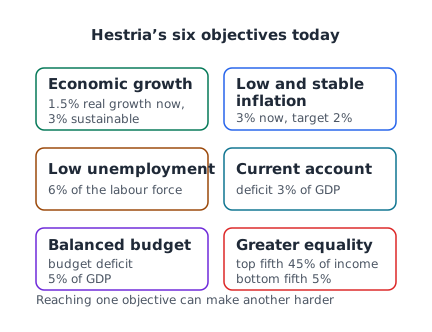
The six macroeconomic objectives, each with Hestria’s reading today against it.
Fiscal Policy on AD/AS
A $10bn rise in government spending, with a multiplier of 2, shifts AD right by $20bn along an upward-sloping short-run supply curve: from E₁ ($800bn, 100) to E₂ ($812bn, 103). The contraction is the mirror: a $10bn fall shifts AD left by $20bn, to E₂ ($788bn, 97).
$10bn more government spending, multiplier 2: AD shifts right by $20bn. Output +$12bn, price level +3.
The Short-Run Phillips Curve
The short-run trade-off between inflation and unemployment: Hestria at X (6%, 3%), and Y (4%, 5%), where a reflationary policy would move it along the curve.
The short-run Phillips curve. 2 points less unemployment, 2 points more inflation.
Macroeconomic Objectives diagrams to save
Open one full size, or save it to revise from.
The Six Macroeconomic Objectives 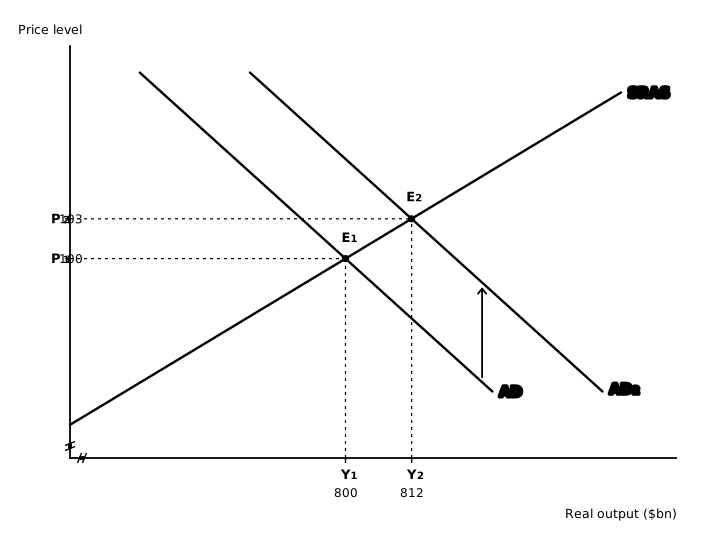
Fiscal Policy on AD/AS: A fiscal expansion 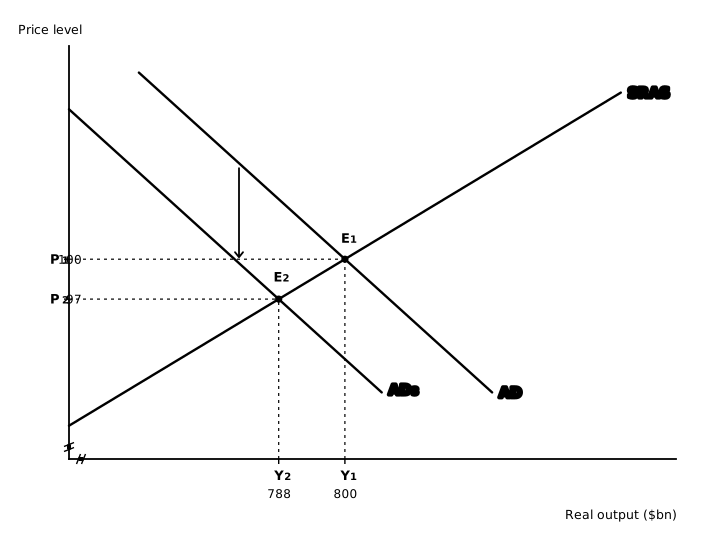
Fiscal Policy on AD/AS: A fiscal contraction 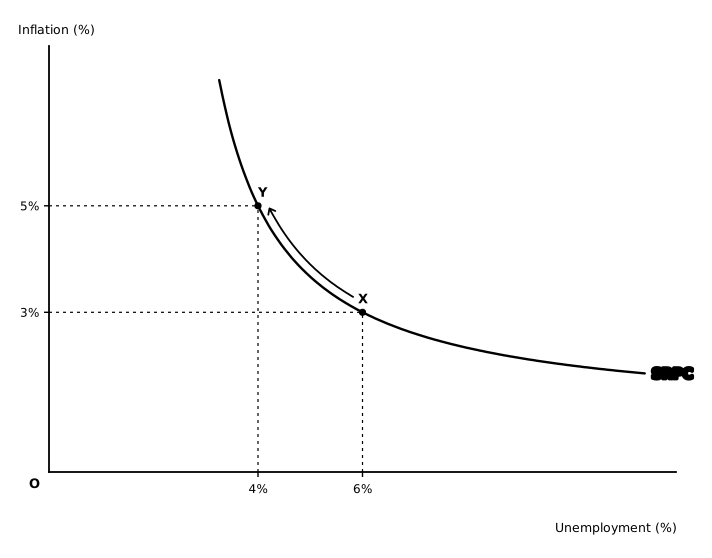
The Short-Run Phillips Curve
Worked calculations
Try it on paper first, then open the working.
A government collects $228bn in tax revenue and spends $260bn. Calculate its budget balance and state whether it is a deficit or a surplus.
A calculation of this kind is testing the direction as much as the arithmetic, so decide which figure is subtracted from which before you write anything down. Appendix 6 allows marks for workings, so set the subtraction out as a line rather than writing a number alone.
$228bn − $260bn = −$32bn (1 mark for the calculation or for showing the subtraction set out). This is a deficit, because spending exceeds revenue (1 mark). An answer giving $32bn without saying which way round it runs has done the arithmetic and left the examiner to guess the economics.
A worker receives $200 a week in benefits. They are offered a job paying $250 a week. Benefits are withdrawn at 80 cents for every dollar earned, and income tax of 10% is paid on the wage. Calculate the increase in the worker's weekly income from taking the job, and the effective marginal deduction rate.
Appendix 6 defines Calculate as a calculation involving several stages, so work through the deductions one at a time and keep a running figure rather than trying to reach the answer in a single line. Decide in what order the two deductions apply before you start, and show every stage: marks are available for workings even where a later figure slips.
Stage 1 — benefit withdrawn: 80% of $250 = $200, so the whole $200 benefit is withdrawn (1 mark). Stage 2 — income tax: 10% of $250 = $25, leaving a net wage of $225 (1 mark). Stage 3 — income in work is $225 against $200 out of work, an increase of $25 a week (1 mark). Stage 4 — the effective marginal deduction rate is the fraction of the $250 lost to withdrawal and tax: ($200 + $25) ÷ $250 = 90% (1 mark). A worker keeping a tenth of what they earn faces a weak incentive, which is why the RATE of withdrawal rather than the level of the payment is the lever this topic points at.
A 6-mark Analyse question
Analyse how an increase in a central bank's policy interest rate reduces the rate of inflation.
0 words
Questions students ask
What are the 4 macroeconomic objectives?
Many textbooks name four main objectives: economic growth, low and stable inflation, low unemployment, and balance of payments equilibrium on the current account. Edexcel IAL Economics (WEC12, spec 2.3.6) adds two more: a balanced government budget and greater income equality. Learn all six for the exam.
How are the macroeconomic objectives measured?
Economic growth is the percentage change in real GDP. Inflation is the percentage change in a consumer price index (CPI). Unemployment is measured with the International Labour Organization (ILO) definition. The budget balance is tax revenue minus government spending: a deficit when spending is higher. The current account balance is shown in the balance of payments.
Why do macroeconomic objectives conflict?
Some objectives conflict: reaching one can make another harder. Lower unemployment can bring higher inflation (the short-run Phillips curve). Faster growth can harm the environment, for example if it comes from more manufacturing. High inflation makes exports less competitive and draws in imports, which can worsen the current account. So a government has to decide which objective matters most at the time.
Test me on all of Macroeconomic Objectives
Every quiz question on the topic, not just the five above.
When you’re done
Edexcel IAL WEC12 · Spec 2.3.6 · A-Level Economics