
5 multiple-choice questions
1Which of the following is NOT one of the five sources of market failure?
2Social cost is equal to:
3In a market for chemicals, the external cost of production is $4 a tonne at every quantity. Using the chemicals harms nobody. The market quantity is 80 tonnes a day, and the social optimum is 60 tonnes. The welfare loss is:
4A factory discharges waste into a river used by towns downstream. The correct diagram shows:
5The free-rider problem arises because a public good is:
The definition examiners want
Define the term 'market failure'.
Say it out loud or jot it down first. Then check it against the mark scheme.
Two marks means two separate things to say, and the second is not a rewording of the first. The specification defines this term by a quantity rather than by a description of a market in difficulty, so decide first what the quantity is being compared against, and make sure that comparison appears in your answer.
Too much or too little of a good is produced and/or consumed (1 mark), compared with the socially optimal level of output (1 mark). The second mark is the comparison: an answer that says the market produces the wrong amount without saying wrong compared with what has given one half of the definition. Descriptions of a market collapsing, of prices being unaffordable or of firms making losses are not this term.
The diagrams to know
Step through each one, then try drawing it yourself.
Private, External and Social
Two tables: private, external and social benefits and costs written as two sums, and the four kinds of externality with the curve each one moves.
Market Failure diagrams to save
Open one full size, or save it to revise from.
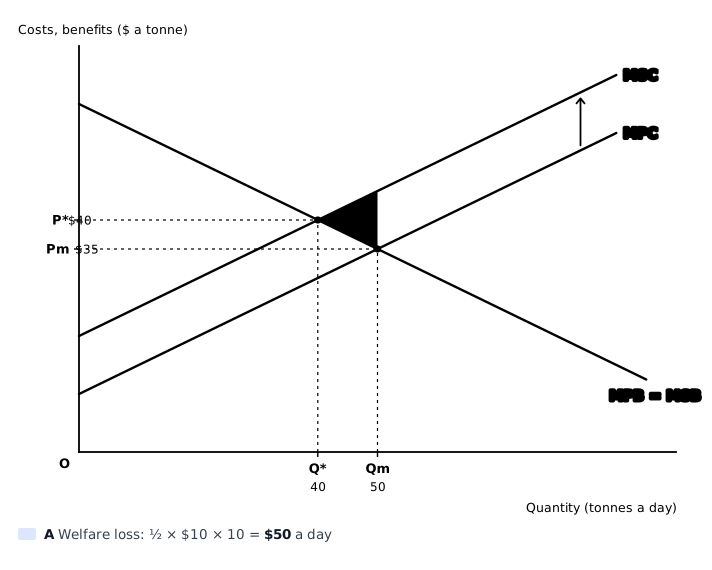
Negative externality of production: the welfare loss 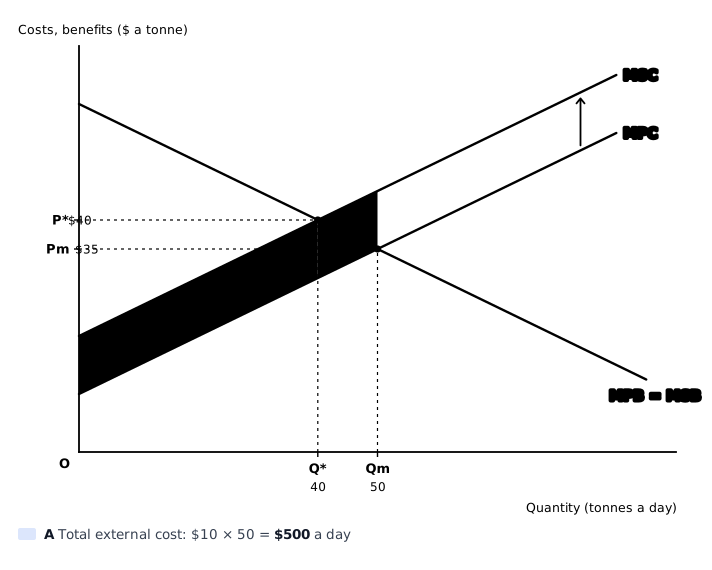
Total external cost 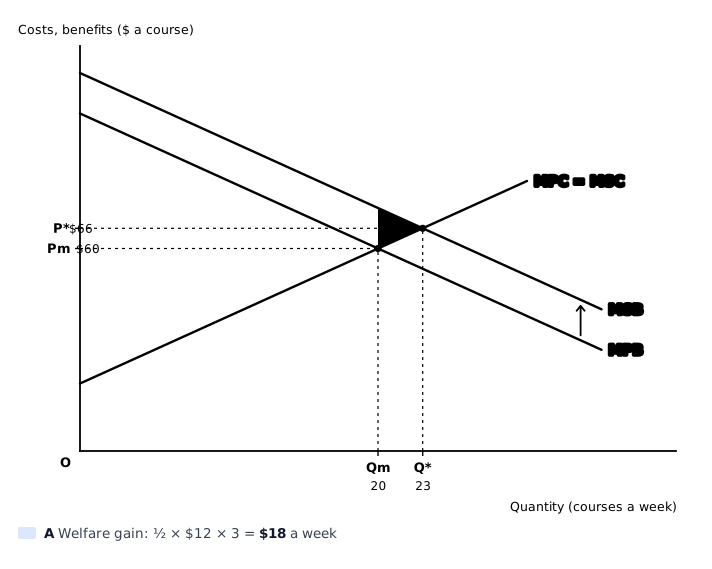
Positive externality of consumption: the welfare gain
Now you draw it
Move the line, mark the point and shade the area. You are marked the way an examiner marks a diagram.
Steel production releases smoke and fumes that impose an external cost of $40 per tonne on people living nearby. The supply curve shows only the producers’ private costs. Draw the marginal social cost curve, mark the socially optimal output, and shade the welfare loss at the market equilibrium.
Negative externality in production. Nothing moved yet. No point marked yet.
Worked calculations
Try it on paper first, then open the working.
Marginal Analysis: the Welfare Loss and the Welfare Gain
IAL 1.3.5 · 2d asks for diagrams using marginal analysis to illustrate the external costs from production, the external benefits from consumption, and the distinction between the market and social optimum positions with identification of the welfare loss or gain areas. All three are here, with both positions marked on every view.
The market settles at 50 tonnes because buyers and sellers weigh only their own benefit and their own cost. Every tonne beyond 40 costs society more than it is worth to the buyer.
In a market for cement, the marginal private cost is given by MPC = 10 + 0.5Q and the marginal private benefit by MPB = 60 − 0.5Q, where Q is tonnes a day. Production imposes an external cost of $10 a tonne. Calculate the market quantity, the socially optimal quantity and the welfare loss.
Three figures are wanted and each one depends on the one before, so work down the page in stages rather than trying to reach the last of them directly. Two of the three are quantities and you find each by deciding which pair of curves meets there — and the two pairs are not the same pair. The third is an area, so once you have both quantities ask yourself what shape it is before reaching for any arithmetic. Appendix 6 defines Calculate as a calculation involving several stages and advises showing workings, and here the workings are what let each stage stand on its own.
Market quantity: set MPB equal to MPC, so 60 − 0.5Q is 10 + 0.5Q, giving Q of 50 tonnes a day (1 mark). Marginal social cost is MPC plus the external cost, so MSC is 20 + 0.5Q (1 mark). Socially optimal quantity: set MPB equal to MSC, so 60 − 0.5Q is 20 + 0.5Q, giving Q of 40 tonnes a day (1 mark). Welfare loss is the triangle between MSC and MPB across the 10 tonnes between the two quantities: half of $10 times 10, which is $50 a day (1 mark). Note that this is not the total external cost, which is $10 across all 50 tonnes, or $500 a day.
In the same cement market, 50 tonnes a day are produced and each tonne imposes an external cost of $10. Calculate the total external cost borne by third parties each day.
This is a shorter calculation than it looks, and the risk is doing the harder one by mistake. Read carefully which quantity the question is asking you to apply the external cost to, and notice that it is asking about a cost borne rather than about a welfare effect — those are two different areas on the same diagram and only one of them is wanted here.
The external cost per tonne is constant, so the total is that cost multiplied by the quantity produced: $10 times 50 tonnes (1 mark), giving $500 a day (1 mark). This is the band between MPC and MSC over every tonne made, not the welfare loss triangle, which is bounded by the social optimum and the market quantity and is $50 a day.
An 8-mark Examine question
Examine the effects of imperfect market information on the allocation of resources in healthcare.
0 words
More questions like these
Try each one on paper first. The calculations have the working behind a tap.
Revvy practice questions. Our question generator wrote these in the style of the exam. They are not Pearson exam questions, and the countries in them are made up. The written questions carry the exam's real marks; the marks on the calculations are for practice.
1Explain · Positive and negative externalities 4 marks
An open-cast mine operates in the fictional economy of Quillon. It plans to expand next year.
- (a) Explain one external cost that an open-cast mine may impose on society. (4)
How to answer an Explain (4) question
Marks: 4, one for each step of a chain. Name one external cost, say who bears it (third parties outside the transaction), develop the consequence, then link it to market failure: the social cost is greater than the private cost.
Part (a)
- B1 Identifies one external cost, for example damage to land or noise
- B1 It falls on third parties (local communities and wildlife) who are not compensated and are not part of the transaction
- B1 Develops the consequence, for example loss of habitats or lower house prices nearby
- B1 So the social cost is greater than the private cost, and the market produces more than the socially optimal quantity (market failure)
2Explain · Positive and negative externalities 4 marks
In the fictional economy of Kovanda, large indoor pig farms have opened near the capital and sell cheap pork. Waste from the farms pollutes streams and neighbours complain about the smell.
- (a) With reference to the information provided, explain why a free market may produce more pork from large indoor farms than is best for society. (4)
How to answer an Explain (4) question
Marks: 2 for knowledge, 2 for applying it to the setting. Name the idea, then use the setting to show why it happens. Use because, this leads to, so.
3Analyse · Non-provision of public goods 6 marks
In the fictional economy of Rhenmark, an emergency warning siren system would help many people, but private firms have no way of making people pay for it.
- (a) Analyse why the price mechanism works for private goods but not for an emergency warning siren system. (6)
How to answer an Analyse (6) question
Marks: 2 for knowledge, 2 for application, 2 for analysis. Build a chain of reasoning in the setting. Each step should follow from the one before.
4Analyse · Imperfect market information 6 marks
In the fictional economy of Keldara, many shoppers do not know how much sugar and salt is in processed food. The labels are small and hard to read, and firms know more about their products than buyers do.
- (a) Analyse how an information gap may lead to a misallocation of resources in the market for processed food. (6)
How to answer an Analyse (6) question
Marks: 2 for knowledge, 2 for application, 2 for analysis. Build a chain of reasoning in the setting. Each step should follow from the one before.
5Examine · Sources of market failure 8 marks
In the fictional economy of Veldora, shares in a group of online retailers have risen in price by 200% in three years. Many buyers say they are buying in order to sell later at a higher price.
- (a) Examine the possible effects on consumers, producers and the government if the price of these shares falls sharply (the bubble bursts). (8)
How to answer an Examine (8) question
Marks: 2 for knowledge, 2 for application, 2 for analysis, 2 for evaluation. Do the analysis first, then add a limit or counter-point and a short judgement.
Want more? The generator makes a new Market Failure question each time, with new numbers and a new setting, and helps you mark it.
Generate a fresh setTest me on all of Market Failure
Every quiz question on the topic, not just the five above.
When you’re done
Edexcel IAL WEC11 · Spec 1.3.5 · A-Level Economics