
5 multiple-choice questions
1In Orana's rice market, at $16, $18, $20 and $22 a bag, the quantity demanded is 280, 250, 220 and 190 bags a day, and the quantity supplied is 160, 190, 220 and 250 bags a day. The equilibrium is:
2At Sela's night market, at $5 a plate the quantity demanded is 400 plates a night and the quantity supplied is also 400, but several stalls are making a loss. The market is:
3Ines pays $18 for a concert ticket. She is willing to pay up to $30 for it. Her consumer surplus on the ticket is:
4The incidence of an indirect tax falls more heavily on:
5A specific tax of $3 a bag is put on rice. Before the tax, sellers needed $8 a bag to supply 500 bags a week. To supply 500 bags a week they now need:
The definition examiners want
Define the term 'equilibrium price'.
Say it out loud or jot it down first. Then check it against the mark scheme.
Two marks means two separate things to say, and the second is not a rewording of the first. Give the condition that defines the term, then give what follows from that condition being met.
The price at which quantity demanded equals quantity supplied (1 mark), so there is no tendency for the price to change (1 mark). The second mark is the consequence, not a restatement: a definition that stops at "where the curves cross" describes the diagram rather than the concept.
The diagrams to know
Step through each one, then try drawing it yourself.
Where Demand Meets Supply
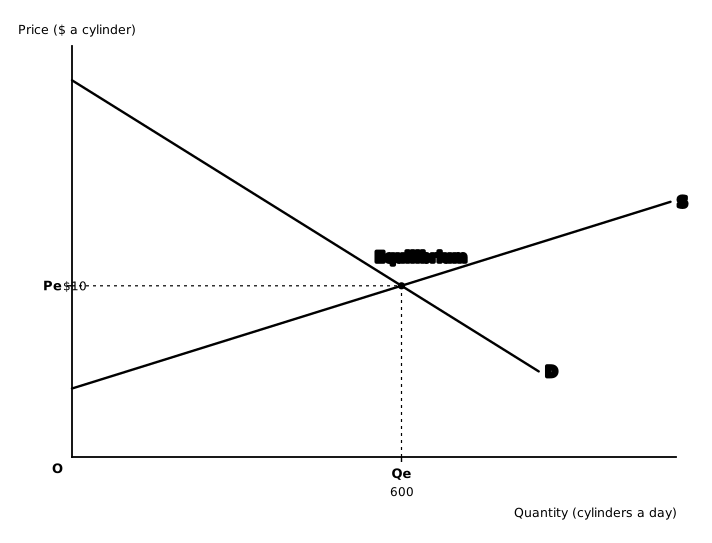
The Sabaya cylinder market drawn as two curves. Demand, D, slopes down and supply, S, slopes up. They cross at $10 a cylinder and 600 cylinders a day: read the crossing off both axes, because an equilibrium is a price and a quantity.
Equilibrium: $10 a cylinder and 600 cylinders a day.
Excess Demand and Excess Supply
Two prices that are not the equilibrium in the Sabaya cylinder market. At $7 the quantity demanded is 750 cylinders a day and the quantity supplied is 300: excess demand of 450. At $13 the quantity supplied is 900 and the quantity demanded is 450: excess supply of 450. Each gap is measured across, at the price. The equilibrium, $10 and 600, is marked so you can see which side of it each price is.
At $7, below the equilibrium price, the quantity demanded is 750 cylinders a day and the quantity supplied is 300. The gap is measured across, at the price. Excess demand: 750 − 300 = 450.
Consumer and Producer Surplus
Both gains at the Sabaya equilibrium of $10 and 600 cylinders a day. Consumer surplus, the buyers' gain, is the triangle ABE: below D and above the price line, $3,600. Producer surplus, the sellers' gain, is the triangle BCE: above S and below the price line, $1,800. Both triangles stop at 600, the quantity traded.
Consumer surplus = ½ × $12 × 600 = $3,600 (above the price, below D) Producer surplus = ½ × $6 × 600 = $1,800 (below the price, above S)
Price Determination diagrams to save
Open one full size, or save it to revise from.
Supply and demand: the equilibrium 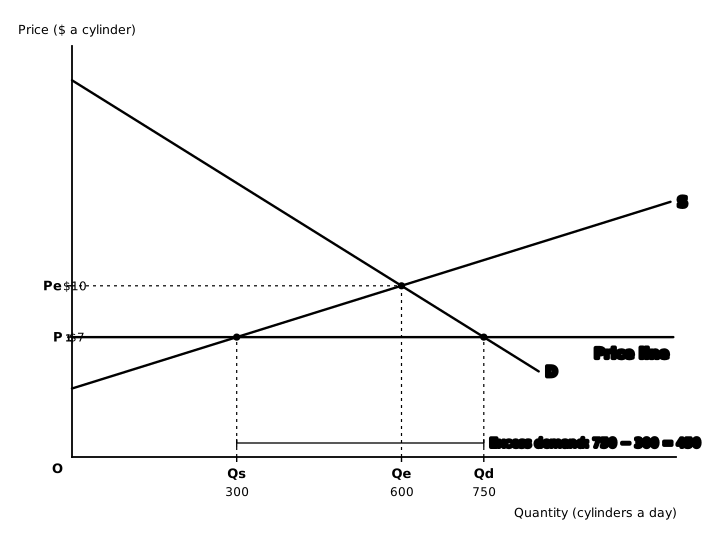
Excess demand below the equilibrium price 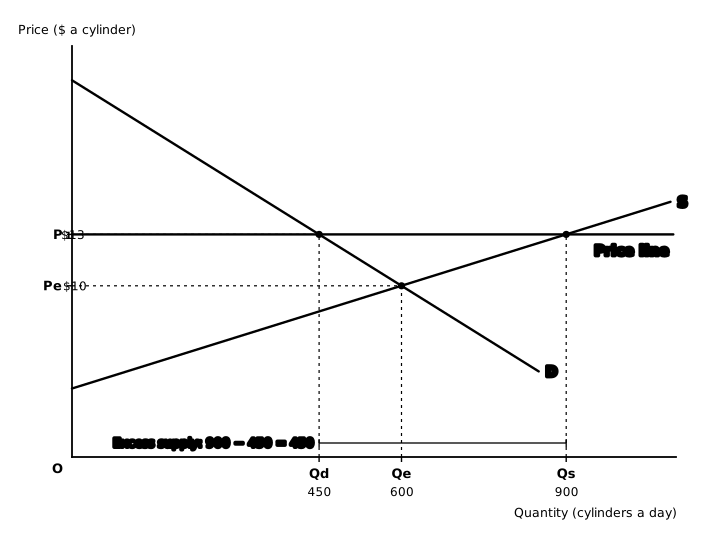
Excess supply above the equilibrium price 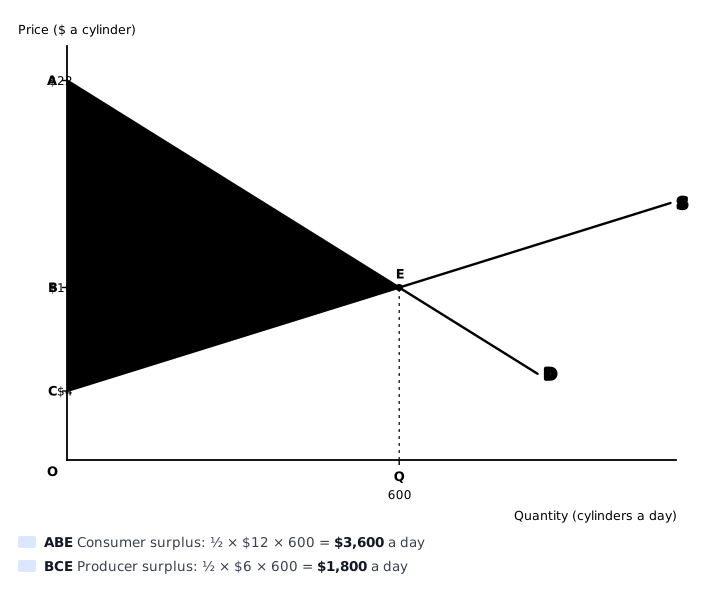
Consumer and producer surplus
Worked calculations
Try it on paper first, then open the working.
A specific tax of $3 per unit raises the price buyers pay from $10 to $12 and reduces the quantity traded from 600 to 500 units. Calculate the consumer incidence of the tax and the revenue the government collects.
There are two prices in this market once the tax is on, and the first part of the question is about the movement in just one of them — decide which before you subtract anything. Then turn to the revenue, which is a rectangle: one side is the tax per unit and the other is a quantity, and the question gives you two quantities of which only one belongs there. Set out each stage on its own line so the workings stand up even if an arithmetic slip creeps in.
Consumer incidence: $12 − $10 = $2 per unit (1 mark), which is 67% of the $3 tax (1 mark). Revenue: $3 × 500 = $1,500 (1 mark), using the quantity traded AFTER the tax rather than the 600 traded before it (1 mark). Appendix 6 defines Calculate as a calculation in several stages and advises showing workings, which is what allows the stages to be credited separately.
An 8-mark Examine question
Examine the effects of a subsidy on cooking fuel on consumers, producers and the government.
0 words
More questions like these
Try each one on paper first. The calculations have the working behind a tap.
Revvy practice questions. Our question generator wrote these in the style of the exam. They are not Pearson exam questions, and the countries in them are made up. The written questions carry the exam's real marks; the marks on the calculations are for practice.
1Calculation · Determination of market equilibrium 6 marks
The table shows the demand and supply schedule for oranges in Fenwick Isles.
Price (£) Quantity demanded (units a week) Quantity supplied (units a week) 4 1,000 720 5 900 760 6 800 800 7 700 840 8 600 880 - (a) State the equilibrium price (£). (1)
- (b) Calculate the excess supply at a price of £8. (2)
- (c) Explain how market forces would move the market to equilibrium if the price were £8. (3)
How to answer a calculation
Marks: M1 for each correct step of method, A1 for the right answer, B1 for each correct point. Write the formula, put the numbers in, then give the answer (elasticities have no unit). If you slip on the arithmetic, the method marks still count.
Part (a)
- A1 £6, where quantity demanded = quantity supplied = 800
Part (b)
- M1 At £8: quantity demanded = 600, quantity supplied = 880
- A1 880 − 600 = 280 units a week
Part (c)
- B1 At £8 quantity supplied is greater than quantity demanded: excess supply (a surplus)
- B1 Unsold stock builds up, so sellers cut the price
- B1 As price falls, quantity demanded extends and quantity supplied contracts until the market clears
2Calculation · Indirect taxes and subsidies 6 marks
The government of Talmora puts a specific tax of £2.00 per unit on boxes of chocolates. Before the tax, the market price was £10.00 and 5,000 units were sold each month. After the tax, the price is £10.40 and 4,250 units are sold each month.
- (a) Calculate the tax revenue the government collects each month. (2)
- (b) Calculate how much of the tax is paid by consumers on each unit. (1)
- (c) Explain why producers bear most of the burden of an indirect tax when demand is price elastic. (3)
How to answer a calculation
Marks: M1 for each correct step of method, A1 for the right answer, B1 for each correct point. Write the formula, put the numbers in, then give the answer (elasticities have no unit). If you slip on the arithmetic, the method marks still count.
Part (a)
- M1 Tax revenue = tax per unit × quantity sold after the tax
- A1 £2.00 × 4,250 = £8,500
Part (b)
- A1 Rise in price = £10.40 − £10.00 = £0.40
Part (c)
- B1 Demand is elastic: quantity demanded falls proportionately more than the rise in price
- B1 A big price rise would lose many sales, so producers keep the price rise small
- B1 Price rises by only a small part of the tax, so producers pay the larger share (here consumers pay £0.40 and producers pay £1.60 of the £2 tax)
3Explain · Determination of market equilibrium 4 marks
In the fictional economy of Vandria, the market for laptops is in equilibrium at a price of $500 each, with 10,000 laptops bought and sold each week.
- (a) Explain how a fall in the price of computer chips would affect the equilibrium price of laptops. (4)
How to answer an Explain (4) question
Marks: 2 for knowledge, 2 for applying it to the setting. Name the idea, then use the setting to show why it happens. Use because, this leads to, so.
4Analyse · Functions of the price mechanism 6 marks
In the fictional economy of Dunmoor, a three-day music festival brings 50,000 visitors to a town that has 5,000 hotel rooms.
- (a) Analyse how the rationing, incentive and signalling functions of the price mechanism work in the market for hotel rooms during the festival. (6)
How to answer an Analyse (6) question
Marks: 2 for knowledge, 2 for application, 2 for analysis. Build a chain of reasoning in the setting. Each step should follow from the one before.
5Examine · Indirect taxes and subsidies 8 marks
In the fictional economy of Lumeria, the government puts an indirect tax of $0.10 on each unit of electricity. Before the tax, the price was $0.50 a unit and 1 million units were sold each day.
- (a) With reference to the information provided, examine the effects of the tax on consumers, producers and the government in the market for electricity. (8)
How to answer an Examine (8) question
Marks: 2 for knowledge, 2 for application, 2 for analysis, 2 for evaluation. Do the analysis first, then add a limit or counter-point and a short judgement.
Want more? The generator makes a new Price Determination question each time, with new numbers and a new setting, and helps you mark it.
Generate a fresh setTest me on all of Price Determination
Every quiz question on the topic, not just the five above.
When you’re done
Edexcel IAL WEC11 · Spec 1.3.4 · A-Level Economics