
5 multiple-choice questions
1A gym raises its monthly fee by 10%, and the number of members falls by 25%. The PED for membership is:
2The price elasticity of demand for a good is calculated as −0.4. This means the good has:
3A ferry operator cuts its fare from $5 to $4, and nothing else changes. The result is:
4The only toll bridge across a wide river estimates that the PED for crossings is −0.3. To increase its total revenue it should:
5A firm wants to know which of its product lines will grow fastest as the economy grows. Which elasticity should it use?
The definition examiners want
Define the term 'price elasticity of demand' (PED).
Say it out loud or jot it down first. Then check it against the mark scheme.
Price elasticity of demand is the responsiveness of the quantity demanded of a good to a change in its own price. It is measured as the percentage change in quantity demanded divided by the percentage change in price.
Because quantity demanded usually falls when the price rises, the value is normally negative. It measures a response at a particular price, so the same good can have a different value at a different point on its demand curve.
Where the marks come from
- 1 The responsiveness of quantity demanded of a good to a change in its own price
- 1 Measured as the percentage change in quantity demanded divided by the percentage change in price
The diagrams to know
Step through each one, then try drawing it yourself.
The Five Values of PED
Five demand curves, each drawn through the same point on the same axes, with the size of PED at that point (the minus sign ignored): perfectly inelastic (vertical, 0), inelastic (steep, between 0 and 1), unitary (1: price and quantity change by the same percentage), elastic (shallow, above 1) and perfectly elastic (horizontal, infinite).
PED = 0
PED between 0 and 1
PED = 1
PED above 1
PED infinite
Size of PED at the dot (the minus sign ignored). Perfectly inelastic: vertical. Inelastic: steep. Unitary: price and quantity change by the same percentage. Elastic: shallow. Perfectly elastic: horizontal. Steep and shallow only compare curves drawn through the same point on the same axes.
Total Revenue and PED
What happens to Tafari's revenue when the fare rises by $2. From $10 to $12, the revenue gained on the tickets still sold ($1,440) is more than the revenue lost on the 80 tickets no longer sold ($800): revenue rises, so demand is inelastic there. From $20 to $22 the loss is bigger and revenue falls: demand is elastic there. Revenue peaks at $15, where PED is −1.
Fare $10 → $12. Old revenue: $10 × 800 = $8,000. Gained: $2 × 720 = $1,440. Lost: $10 × 80 = $800. Revenue rises by $640, $8,000 → $8,640: demand is inelastic here.
Price Elasticity of Demand diagrams to save
Open one full size, or save it to revise from.
Demand curve drawn from a demand schedule 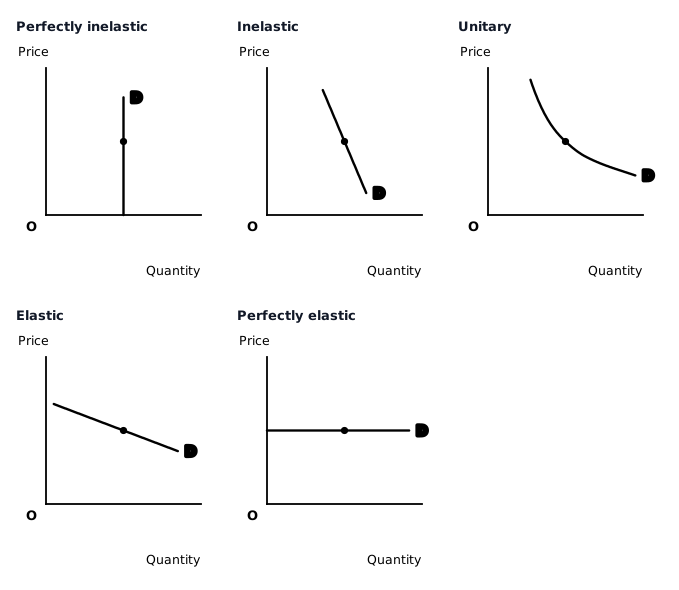
The five values of PED 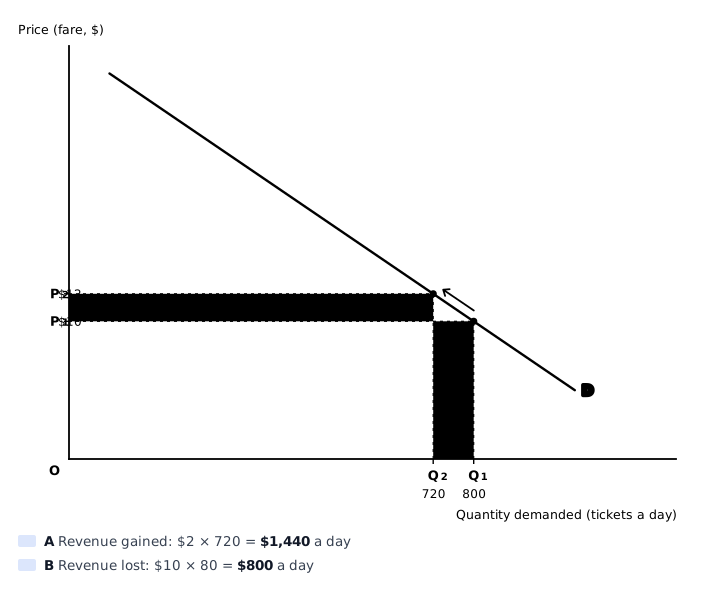
PED and total revenue: a price rise, revenue rises 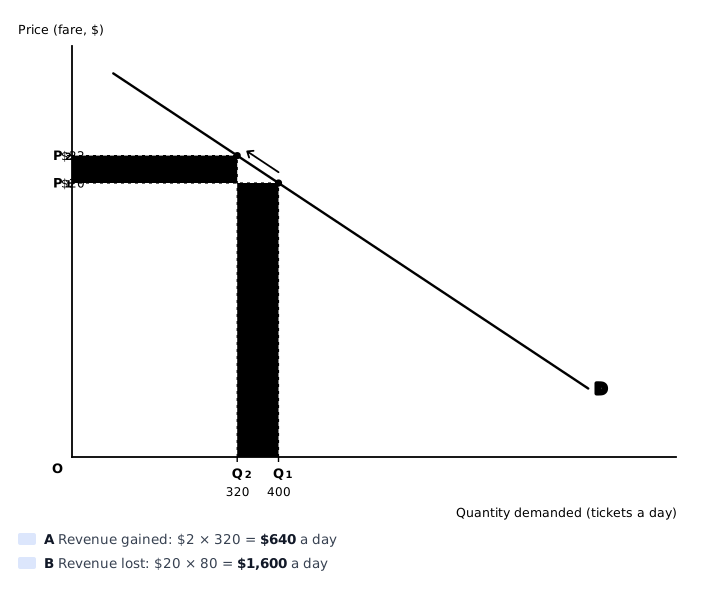
PED and total revenue: a price rise, revenue falls 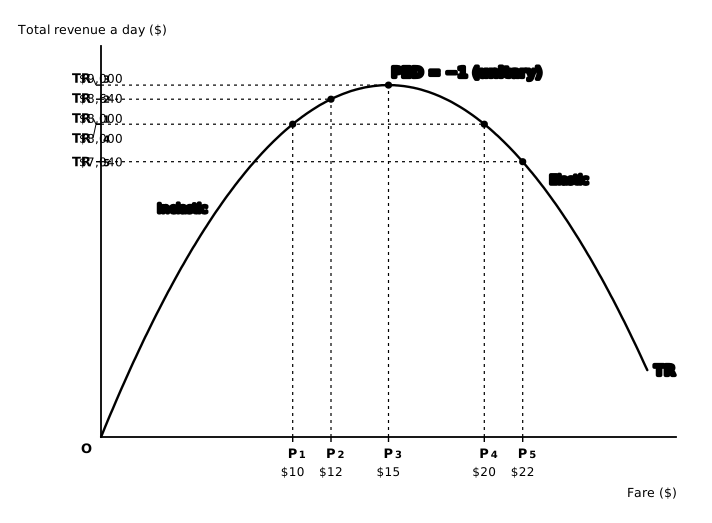
Total revenue at every price
Worked calculations
Try it on paper first, then open the working.
Tafari's Demand Curve
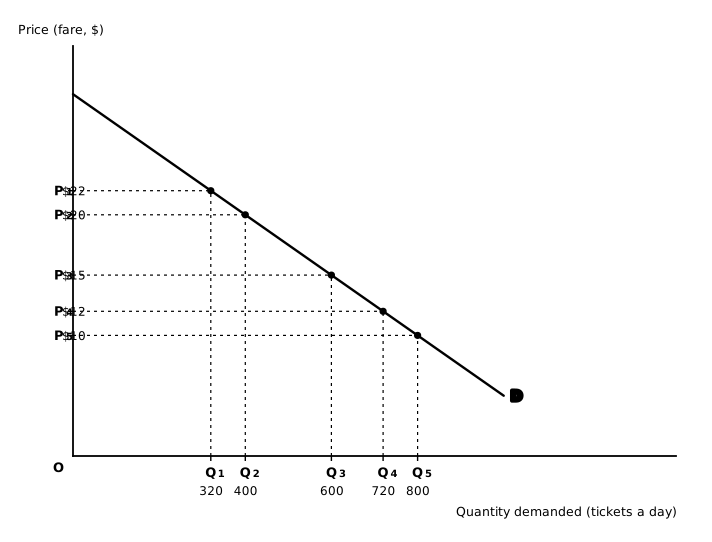
Tafari Coaches' daily demand schedule plotted as a curve, D: 320 tickets at a fare of $22, 400 at $20, 600 at $15, 720 at $12 and 800 at $10. It slopes down: the lower the fare, the more tickets people want.
Each point is one row of the demand schedule: the lower the fare, the more tickets people want. 320 tickets at a fare of $22, 400 at $20, 600 at $15, 720 at $12 and 800 at $10.
The demand schedule in this chapter's diagram gives Tafari's daily ticket sales at each fare. Using the $20 and $22 rows — 400 tickets and 320 tickets — calculate the price elasticity of demand and state what it shows.
PED is the percentage change in quantity demanded divided by the percentage change in price. When the fare rises from $20 to $22, quantity demanded falls from 400 to 320 tickets a day. The percentage change in quantity demanded is (320 − 400) ÷ 400 × 100 = −20%, and the percentage change in price is (22 − 20) ÷ 20 × 100 = +10%.
So PED = −20 ÷ 10 = −2. The size of the answer, 2, is greater than 1, so demand is price elastic between these fares: quantity demanded falls proportionally more than the fare rises. Raising the fare therefore lowers Tafari’s total revenue, from $20 × 400 = $8,000 a day to $22 × 320 = $7,040 a day.
| Marking point | Marks |
|---|---|
| Percentage change in quantity demanded: (320 − 400) ÷ 400 × 100 = −20% | 1 mark |
| Percentage change in price: (22 − 20) ÷ 20 × 100 = +10% | 1 mark |
| PED = −20 ÷ 10 = −2 | 1 mark |
| What it shows: the size, 2, is above 1, so demand is price elastic between these fares, and quantity demanded falls proportionally more than the fare rises | 1 mark |
| Total | 4 |
Read the $10 and $12 rows off the demand schedule in this chapter's diagram — 800 tickets a day and 720 a day. Calculate total revenue at each fare and state which fare a revenue-maximising operator should choose.
Total revenue is price multiplied by the quantity sold. At a fare of $10, Tafari sells 800 tickets a day, so total revenue is $10 × 800 = $8,000 a day. At $12 it sells 720 tickets a day, so total revenue is $12 × 720 = $8,640 a day.
A revenue-maximising operator should choose the $12 fare, because it brings in $640 a day more than the $10 fare. Revenue rose when the fare rose, so demand is price inelastic between these fares: quantity demanded fell proportionally less than the fare rose. This compares revenue, not profit: it is the money coming in before the cost of carrying the passengers is taken off.
| Marking point | Marks |
|---|---|
| Total revenue stated as price × quantity sold | 1 mark |
| Total revenue at $10: 10 × 800 = $8,000 a day | 1 mark |
| Total revenue at $12: 12 × 720 = $8,640 a day | 1 mark |
| The $12 fare chosen, because it brings in more revenue a day than the $10 fare | 1 mark |
| Total | 4 |
A 6-mark Analyse question
Analyse two factors that influence the price elasticity of demand for a branded soft drink.
How to approach it: Choose two factors and take each one to a consequence for this drink, rather than naming several. For each, ask how easily a buyer could switch to another drink or do without it, and what that means for the firm’s price.
0 words
More questions like these
Try each one on paper first. The calculations have the working behind a tap.
Revvy practice questions. Our question generator wrote these in the style of the exam. They are not Pearson exam questions, and the countries in them are made up. The written questions carry the exam's real marks; the marks on the calculations are for practice.
1Calculation · Price, income and cross-elasticities of demand 6 marks
A business in Veldora changes the price of cinema tickets from £12.00 to £9.00. The quantity demanded changes from 800 to 920 tickets per week.
- (a) Calculate the price elasticity of demand (PED) for cinema tickets. (3)
- (b) Explain what your answer shows about the effect of this price change on the firm's total revenue. (3)
How to answer a calculation
Marks: M1 for each correct step of method, A1 for the right answer, B1 for each correct point. Write the formula, put the numbers in, then give the answer (elasticities have no unit). If you slip on the arithmetic, the method marks still count.
Part (a)
- M1 %Δprice = (9 − 12) ÷ 12 × 100 = −25%
- M1 %Δquantity demanded = (920 − 800) ÷ 800 × 100 = +15%
- A1 PED = (+15%) ÷ (−25%) = −0.6 (accept 0.6 without the sign)
Part (b)
- B1 Demand is price inelastic (the value is less than 1 in size)
- B1 The % change in quantity demanded is smaller than the % change in price
- B1 So total revenue falls because the price effect is bigger than the quantity effect
2Calculation · Price, income and cross-elasticities of demand 6 marks
A business in Nestoria changes the price of gym day passes from £40.00 to £45.00. The quantity demanded changes from 1,600 to 1,360 passes per week.
- (a) Calculate the price elasticity of demand (PED) for gym day passes. Give your answer to 2 decimal places. (3)
- (b) Explain what your answer shows about the effect of this price change on the firm's total revenue. (3)
How to answer a calculation
Marks: M1 for each correct step of method, A1 for the right answer, B1 for each correct point. Write the formula, put the numbers in, then give the answer (elasticities have no unit). If you slip on the arithmetic, the method marks still count.
Part (a)
- M1 %Δprice = (45 − 40) ÷ 40 × 100 = +12.5%
- M1 %Δquantity demanded = (1,360 − 1,600) ÷ 1,600 × 100 = −15%
- A1 PED = (−15%) ÷ (+12.5%) = −1.20 (accept 1.20 without the sign)
Part (b)
- B1 Demand is price elastic (the value is greater than 1 in size)
- B1 The % change in quantity demanded is larger than the % change in price
- B1 So total revenue falls because the quantity effect is bigger than the price effect
3Calculation · Price, income and cross-elasticities of demand 5 marks
In the fictional economy of Veldora, average monthly household income falls from £1,200 to £900. Demand for electricity changes from 400 to 360 units per month.
- (a) Calculate the income elasticity of demand (YED) for electricity. Include the sign. (3)
- (b) State what your answer shows about the type of good, and explain. (2)
How to answer a calculation
Marks: M1 for each correct step of method, A1 for the right answer, B1 for each correct point. Write the formula, put the numbers in, then give the answer (elasticities have no unit). If you slip on the arithmetic, the method marks still count.
Part (a)
- M1 %Δincome = (900 − 1,200) ÷ 1,200 × 100 = −25%
- M1 %Δquantity demanded = (360 − 400) ÷ 400 × 100 = −10%
- A1 YED = (−10%) ÷ (−25%) = 0.4
Part (b)
- B1 A normal good with income inelastic demand, often called a necessity (YED is between 0 and +1)
- B1 Quantity demanded changes by a smaller percentage than income, in the same direction
4Calculation · Price, income and cross-elasticities of demand 4 marks
In Wexmoor, the price of margarine rises by 5%. As a result, the quantity demanded of butter changes from 500 to 550 units a week.
- (a) Calculate the cross elasticity of demand (XED) of butter with respect to the price of margarine. Include the sign. (2)
- (b) State what your answer shows about the relationship between butter and margarine, and explain. (2)
How to answer a calculation
Marks: M1 for each correct step of method, A1 for the right answer, B1 for each correct point. Write the formula, put the numbers in, then give the answer (elasticities have no unit). If you slip on the arithmetic, the method marks still count.
Part (a)
- M1 XED = %Δ quantity demanded of butter ÷ %Δ price of margarine
- A1 %Δ quantity demanded of butter = (550 − 500) ÷ 500 × 100 = +10%; XED = (+10%) ÷ (+5%) = +2
Part (b)
- B1 Butter and margarine are substitutes (XED is positive)
- B1 A rise in the price of margarine makes consumers switch to butter, so demand for butter rises
Want more? The generator makes a new Price Elasticity of Demand question each time, with new numbers and a new setting, and helps you mark it.
Generate a fresh setTest me on all of Price Elasticity of Demand
Every quiz question on the topic, not just the five above.
When you’re done
Edexcel IAL WEC11 · Spec 1.3.2 · A-Level Economics